Monday, August 20, 2012

Mystery Animal - We Have a Winner!

The winner of the non-existent prize goes to my friend and favorite Corgi-owner Kalia, who classified and described the animal as...

"the very rare, highly elusive bulbous nosed sheep dragon.  They are high sought after for the medicinal soup created from their bulbous nose's inner goodies (aka boogies) and their plush tails which are used for wigs for the insanely rich and and slightly insane.  They do not make great pets due to their propensity for sitting on small children which often results in asphyxiation and skull crushing but if properly trained are wonder modes of transportation because they fly and you can avoid all the touristy white women on motor bikes.

or is this a turtle?  it's hard to tell from the picture quality."

Nope, you were right the first time! It's a dragon, according to the young woman who worked the front desk in one of the hostels where I stayed. Thanks for that thorough description, Kalia! 


Friday, August 3, 2012

Apologies...

...for the delay on this blog. My flash drive is annoyed with me for plugging it into so many questionable internet cafe computers, leaving me unable to access my photos. And really, what would this blog be without my sub-par photography? Only my sub-par writing.

So while I wrestle with that and you continue to hold your breath for the next proper post, let's have a photo challenge.

What is this animal?


Photos taken at the Imperial City in Hue, Vietnam. 


Pictures taken from all angles to aid in identification.


Any guesses?

The answer according to the sweet Vietnamese girl at the front desk of my hostel, in the next post. 


Saturday, July 7, 2012

Tam Coc: Hey, More Karsts!

From Hanoi I grabbed a minivan down to Ninh Binh, a little town a few hours south of Hanoi with a lot of guesthouses and no restaurants. (The people are lovely, though- people said hello and practiced their English at me, I got a wordless high-five from a gardener, and an old man thrust his one-year-old granddaughter into my arms when I applauded her toddling.) It's not really set up for tourists, but it should be, because it's the closest town to Tam Coc, which is very, very worth seeing.


Tam Coc means "three caves", and is a site full of rice fields and karst towers along the Ngo Dong River. There have been a lot of karsts on this blog, but I liked these the best. When you're touring them you pass right under and through them, and even though I did the very same thing in Halong Bay in a kayak, they seem so much more striking when they're jutting out of the green high grasses of the rice fields. 

The only way to see Tam Coc is by renting a boat, rowed by local women who do so with their feet. 


They row you through a path carved through the rice. 


I don't know what to say about this place, except that it seems otherworldly and mystical. The karsts of Halong Bay or Southern Thailand rose from the water, which, although dramatic, isn't unfamiliar. My brain, I think, interpreted them along the same lines as sudden-rising islands or maybe icebergs. But here you have two seemingly incongruous landscapes occupying the same space.
Pagoda on top of a karst. How did they get that up there? 


When we went into this cave I kept waiting for the ride to kick in.


It reminded me of the Pirates of the Caribbean roller coaster at Disney World. But the speed stayed constant and nothing jumped out at me.


More superb photography. 
It was dark and spooky and all kinds of awesome. 

And then back out into the overcast day and the fortress of the karsts to see blue-grey cranes dancing in the rice and a lost white goat picking his way along a sheer rock face, a hundred feet up. 


After we finished paddling around and the locals tried to sell me everything from Oreos to handicrafts, I climbed back onto my rented motorbike and went to find Bich Dong, a pagoda built into Ngu Nhac Mountain dating back to 1428. 


There are three structures layered up the mountain, so I climbed up to the first...


And then to the second...


And through a cave with shrines inside...


 to exit here...


And find this view. 


But then I scrambled up a little farther to the highest structure:


and higher on a rocky trail just to do it and to look out on this:  


...which was pretty sweet. 

I scrambled down and made my way out, and climbed back on my motorbike to tool around the countryside for a bit, where houses were backed up right against the rock.


The road exiting Tam Coc had long rice fields and houses with the karsts hunched behind it all on one side.


And on the other, some kind of industrial something, which added a sort of dystopian effect.  


And a beautiful young girl was washing clothing in a drainage ditch. 


Jeez, I have real problems with achieving level horizons. 

When I got back to the highway that runs between Ninh Binh and Tam Coc, I almost immediately hit some very intense traffic of both vehicles and pedestrians. 


When I reached the bottleneck I found that there hadn't been an accident; the traffic was caused people crowding in the road, in the median, and on the train tracks next to the road to get a glimpse of a Buddhist monk on a pilgrimage, who was getting to wherever he was going using full prostrations. 


This is another photo of traffic. I couldn't get close enough to see the monk, who was a rockstar. 
That means he was doing this:


Over and over and over again. But each time he got back up he brought his feet to where his hands had been, and made his way forward that way, rather than taking any actual steps. Some pilgrims doing full prostrations end up with thick callouses on their noses and foreheads (and, one would imagine, knees and hands) from touching them to the ground countless times along their way.  It's extremely hard core. 

He was preceded by women from the town sweeping the pavement ahead of him, a nun overseeing that, and two nuns following him, singing. When I lingered at the head of that procession to try unsuccessfully for a decent photo, the nun at the head of the line grabbed me and asked (through a bystander) where I was from. I said the U.S. (I was the only Westerner in the crowd), and she rummaged about in her bag and handed me a data CD with Vietnamese on it. I thanked her for it, and she patted me on the shoulder. Then I sped off, because the police were starting to get pushy.

I'm still carrying that CD, because I'm not carrying any technology to see what's on it. I'm sure it's in Vietnamese and that I won't understand a bit of it, but how could I throw something like that away?

Wednesday, July 4, 2012

Halong Bay

Everyone in Hanoi insists that you must, must go to Halong Bay. To come to Vietnam and not see the sun rising over the majestic, jewel-like karsts and sparkling off the bay's sapphire water from the deck of your orange-sailed junk is a crime, a crime! 


Yeah, that photo isn't mine. I didn't see sunrise. Or sunset. Vietnam is disgustingly expensive by Southeast Asian standards, so I couldn't afford that nonsense. I also saw some pretty good karst action in Southern Thailand and felt that Halong Bay couldn't be that much better. So I took a day trip and spent just a few hours there. And even though it was extremely overcast and the cheap tour hurried us through our activities in order to get back to Hanoi before midnight, it was still worth doing.  

I and several other tourists, including a Chinese woman named Yuan who became my Halong Bay buddy, climbed aboard a ferry and headed out into the bay. Even darkened by clouds, the place was pretty beautiful. 

Slightly skewed photo courtesy of being on a boat. 
But it wasn't Halong Bay's best day. Here's another one from the internet showing the place in sunny weather. 


You can see why the local legend tells that the islets were once jewels and jade, designedly dropped by dragons to assist the Vietnamese in defending their country from the evil invading Chinese with a wall of staggered stone.

Our first stop was at a cave discovered by a fisherman a few years ago during a thunderstorm. Caves are apparently a big tourist draw in Halong, so whoever is in charge of these things has recently opened a few more to the public. 


It must have been quite something when the fisherman stumbled on it. Unfortunately, that same body who is in charge of these things decided to light the cave with multi-colored lights, which made it look like it was a few strobe lights away from opening as a nightclub.


Our adorable, pint-size guide Chau led us around the cave, pointing out unicorns, dragons, and turtles in the rock formations. Sometimes they looked more or less like the things they were supposed to be, like this turtle, for whom people left offerings:


What is a stone turtle going to do with money? Also, ignore the camera strap. I was really on a roll in the photography department that day. 
Less so with this one, which is supposed to be a dragon. Whoever does these things even added little red eyes in the rock. 


See it? Me neither. 
She pointed out all manner of things in the rock formations and the shadows they cast. I particularly liked this exchange she and I had:

Chau: Do you know the novel Romeo and Juliet by William Shakespeare?

Me: Play. 

Chau: What?

Me: Nothing. Yes. 

Chau: Well, in this cave we have our own Romeo and Juliet. Do you see Romeo there? (points at a shadow 
vaguely resembling a man.) And can you see Juliet? 

Me: (mostly to myself) Well, I'm going to guess that it's the balcony scene. So she must be somewhere up...

Chau: Yes! There she is! (Points at a vaguely woman-shaped shadow.) Now in the novel, one of them dies. 

Me: Actually...

Chau: But in this cave, they do not die. They have children! Do you see the children? (points at lumps of rock.) It is better that way. 

Me: ....I...okay. 

After that brief appreciation of fine literature, we got back on the boat and headed further into the bay. Yuan and I sat at the blunt bow and dangled our feet over the water, breathing in the breeze and watching the faces of the islands change shape as we passed them and discovered their irregular facets. This was my favorite part of the trip, and I wish I could have spent all day doing it. 


But it was only about 25 minutes before we reached the fishing village which I suspect now makes a living more on tourism than fishing. 

Upon our arrival we were immediately set upon by floating fruit vendors. I bought a dollar's worth of rambutan, and was given about six of them (you'd get twenty or so in Hanoi). 


Then Yuan and I climbed into kayaks and set out for a 30 minute paddle. She had never kayaked before, but was a quick study under my expert tutelage. She also surprised me with her wicked sense of humor, and we giggled while making up stories about the rock faces that involved dragons and princesses and the evil Chinese attacking the hapless Vietnamese (wildly disrespectful, I know). 


But mostly we were pretty quiet as we glided through low caves and into empty, sheltered inlets. 


And then, all too soon, we climbed out of our battered kayaks and onto our boat to cruise back to Halong City. 


And from there to bus back to Hanoi and the monsoon that was dumping buckets of water on the city. 

Thursday, June 28, 2012

Sapa: Sick of Mountains Yet?

From Hanoi I took the night train to Sapa, which is just about the only tourist destination in northwest Vietnam. So off I went. 

Sapa is a ways away in towering mountains. The best way to get there is by night train, which takes about 12 hours. I was relieved to hear that, as I'd had enough mountain bus trips in Laos to last a few lifetimes. 

When I got to the train station I wandered around a bit looking for the right platform and train. I was trying to ask the station master where I was supposed to be when a tiny, wizened old man ran up to me, grabbed my ticket, and scurried off, beckoning me to follow. I did, all the while impotently insisting that he give me back my ticket, and preparing to tackle him should he break into a run. He took me across a few lines of tracks to my train, then onto the train, where we were met by a conductor. My breathless complaint to the conductor that the little man would not let go of my ticket was drowned out by the thief's rapid-fire Vietnamese, and the conductor just chuckled. 

The little man led me further, to a bunk that looked like this: 


and was pleasingly empty. I snatched my ticket back from him, and he held out his newly-empty hand for a tip. I wheezingly declined.

Good thing, too- after sitting in this empty cabin for a few minutes I began to study my crumpled ticket. It was all Vietnamese to me, but the numbers on it seemed in no way to correspond with the numbers of the berth or the bunks. I ducked my head out the door and showed it to a passing conductor, who laughed at me, and led me to a berth at the other end of the car. It was occupied by three Vietnamese businessmen. The conductor said something to them about me and they all shared a laugh too. Then they laughed again when I clambered up on the only remaining bed, which was a top bunk. I'm very popular in Southeast Asia.

In any case, I arrived in Lao Cai, the unattractive town an hour from Sapa where the train stops, then took a van up into the mountains to the town itself. I checked into a hotel, took a nap (the night train is not incredibly restful) and went to wander the town.

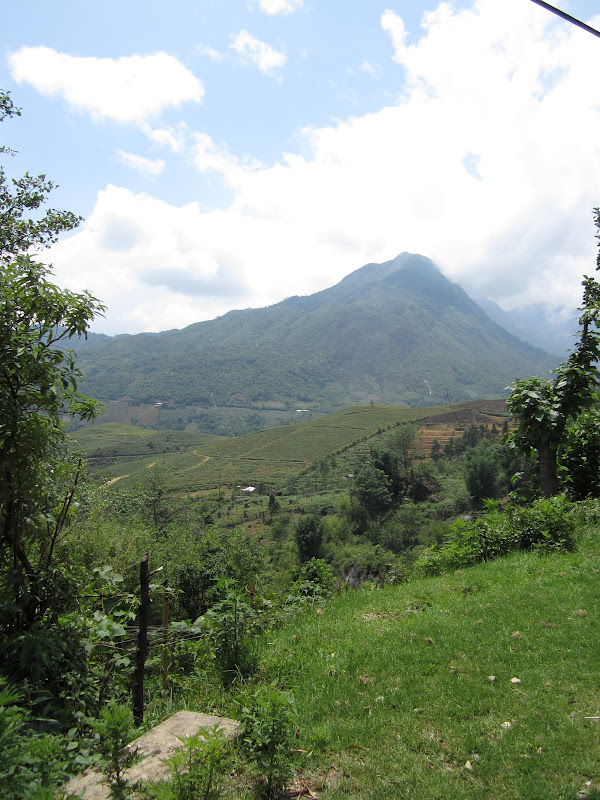
Sapa is a small town perched on a steep hillside in the Hoang Lien Son mountain range, looking out over a terraced valley and misty foothills escalating into steeper slopes.


It is gloriously cool up there at 1650 m. above sea level, which was mostly what brought me there. The town's economy used to be based on small-size agriculture, but that's been taken over by tourism: wikipedia tells me that while Sapa received 4,860 tourists in 1995 that number had exploded to 138,622 less than ten years later in 2003. There's constant construction going on as entrepreneurs hasten to erect new hotels for all the visitors. Standing on my hotel's third-floor balcony, overlooking the main street and watching building in all directions, I couldn't help but feel as if I was watching, and hastening, Sapa's ruin by tourism.


Whoops.  

Sapa's population of 36,000 consists mainly of minority groups, such as the Hmong, which are not such a minority here at 52%. If you come to Sapa, you will meet them, whether you'd like to or not. Walk out of a hotel or restaurant or shop and they accost you with wall hangings and purses and bracelets and headbands and anything else that can be embroidered. Their selling strategy is to follow you and tell you about their lives until it becomes personal, and then follow you some more, until you finally buy something.

It works pretty well. These ladies followed me around until I bought an embroidered headband and several bracelets. 
They may look sweet, but they're...actually very sweet. 
These women spoke excellent English, which they learned completely from tourists. They travel to and from Sapa from their mountain village every day, sometimes by motorbike but mostly on foot, which takes almost three hours. They all got married young (like, 15 years old young) and had a few kids, and were amused to learn that I was 28 and unmarried. They were even more amused by my suggestion that I might come to their village and find a husband there. 

The next day I rented a motorbike and headed out into the countryside. And this is really where Sapa shines. 

Every arable piece of land is terraced and planted. Some of the hillsides have been cut in such a regular, precise, pleasing fashion that the whole hill looks like an ancient step pyramid. Steep, stunning, cloud-veiled peaks provide a breathtaking backdrop, contrasting orderly agriculture with ragged untamable heights.


I spent most of the day on this snaking road, leaning into the mountains, where I saw more cows than vehicles.


 I drove until I was out of the farmland, where the ranges just melted down into the valleys and it was all carpeted with jungle. It made me wish that I had bought the motorbike and taken my pack, and that I could just stay on that road and see where it took me.  


But I'm a much too cautious person for that. In any case, tt was a truly excellent way to spend a day.